A Analytical Perspective on the Controversial Decision in Manchester Derby
Premier League referees' chief Howard Webb has defended the decision not to show Man Utd's Diogo Dalot a red card in the recent Manchester derby. Get insights into the reasoning behind the call and reactions from key figures.
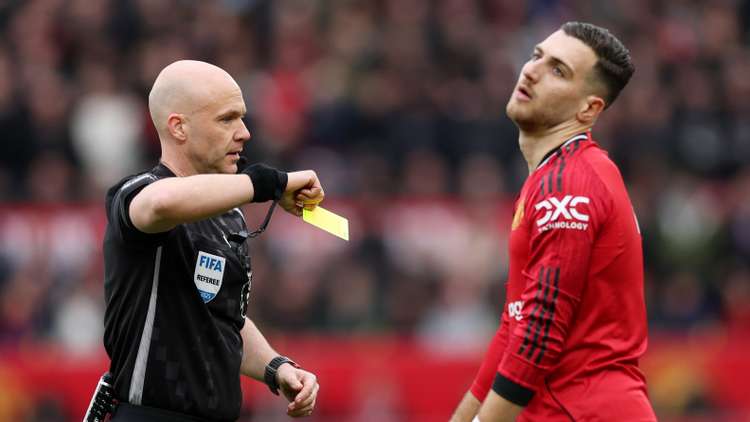
Premier League referees' chief Howard Webb has said the match officials were correct in their decision not to send Diogo Dalot off during Saturday's win for Manchester United over rivals Manchester City at Old Trafford. Dalot was shown a yellow card for an ugly foul on Jeremy Doku by referee Anthony Taylor which was supported by VAR Craig Pawson. Webb has now explained why he thinks the officials got the decision spot on.Dalot's challenge on Doku has sparked plenty of debate after the Manchester United star escaped a red card despite catching the Manchester City forward on the knee with his studs. The Premier League Match Centre offered an explanation on why Dalot was not sent off in a post on X that read: "The referee’s call of yellow card to Dalot for a reckless challenge was checked and confirmed by VAR – with the contact deemed to be glancing and not with excessive force."Yet television pundit Alan Shearer was adamant Dalot should have been handed his marching orders. He said on Match of the Day: "I think VAR got that terribly wrong. For me that was a clear red card. Forget about whether the contact was 'glancing' or not. I can understand why the referee hasn't given it, it might have been difficult for him to see it, but when the VAR has two professionals looking at that it should have been a very easy decision to give a red card."Webb has now shared his verdict on the challenge and explained why he does not think it warranted a sending off. He said on Match Officials Mic'd Up: "The officials on the field saw the actions of Dalot, they saw him stretch forward with his foot, he touches the ball, and then there's contact on Jeremy Doku. They deemed that to be a reckless action and therefore worthy of a yellow card. I know other people think it's clearly red. I don't agree - I think there's a mix of considerations. I know that when we look at this, we see that the point of contact is on the knee, but we also have to factor in speed, force and intensity. You'll not see many red cards in the Premier League for serious foul play that don't involve those things."Now, we evaluate those things through a full-speed view of the incident. Without looking at it at full speed, you get kind of a distorted view. You don't get a true picture of how much force and speed there was in the challenge. That foot touches the knee, comes off pretty quickly. We can see on slow-mo that it does touch that knee. But at full speed, when you play it in real time, you can see there's not a great deal of speed in the action. Not a lot of intensity. We were heavily criticised a few years ago for using slow motion and freeze frames, because people said this is not reality, it's not how the game is played. When you slow it down it can look a lot worse - and it does. When you freeze frame it, you can make a lot of situations look like red-card offences. So, it's difficult for me to hear people make a judgment on this just by analysing freeze frames and slow motion, coming to the consideration that it's red on that basis."Looking for smarter football bets? Get expert previews, data-driven predictions & winning insights with GOAL Tips on Telegram. Join our growing community now!City manager Pep Guardiola admitted his side were second best against United but did feel Dalot should have seen red. He told Sky Sports: "He should be sent off, it's a red card since the game. But it will be poor as a manager, I've never been that, if you analyse that, to win or lose a game. I said to Michael and all the players right now here, they deserve that change. It's a red card - definitely. But that will not make us grow up. The new players knew exactly what they had to do, but it's what it is. I could say that [the red would have changed the game] and blame. We will not grow up, we will not move forward. But what happened is not a surprise at all for me, but it's not happened in the past."When I arrived here, one action, it happened with these referees in Chelsea, in Man City, Chelsea-Gundogan with [N'Golo Kante]. So now I start to realise, it's not about that. Because with that, we grow up, always talking. We have to look at ourselves, honestly. So, what happened in the situation? We should differently, maybe, but who knows. There are a lot of teams that win with ten against 11, and I get the feeling with the game that we played, maybe we'll have no win. If the players have excuses for that reason, we'll be in trouble in the future. We have to look at ourselves, and today it's simple."Add GOAL.com as a preferred source on Google to see more of our reportingManchester United went on to win the game 2-0 to make it a perfect start for manager Michael Carrick in his first game since being appointed caretaker boss. He now faces another tricky fixture on Sunday when the Red Devils travel to Arsenal in the Premier League.
Howard Webb's Justification
Howard Webb, the referees' chief, supported the call to give Diogo Dalot a yellow card instead of a red during the Manchester derby. Webb explained that the match officials deemed Dalot's challenge on Jeremy Doku as reckless but not deserving of a sending off. He emphasized the importance of considering factors like speed, force, and intensity in such decisions.
The Impact of Full-Speed Analysis
Webb highlighted the significance of evaluating incidents at full speed rather than relying solely on slow-motion replays or freeze frames. He argued that a real-time view provides a more accurate representation of the force and speed involved in a challenge, cautioning against making judgments based solely on manipulated footage.
Guardiola's Perspective
Manchester City manager Pep Guardiola expressed his belief that Diogo Dalot should have been shown a red card for the tackle in the Manchester derby. However, Guardiola stressed the importance of not dwelling on refereeing decisions and instead focusing on team performance and improvement.
Manchester United's Victory
Despite the contentious decision, Manchester United emerged victorious in the derby, securing a 2-0 win under caretaker manager Michael Carrick. The result marked a positive start for Carrick, who now faces a challenging fixture against Arsenal.